
“Its easy to get the players. Getting them to play together ,that’s hard part”
Casey Stengel
Team management plays a vital role for effectively control and execute your projects. It’s really a big topic to cover but i will take baby step to trigger an essence towards team.There are following stages involve in team management.
- Team Formation
- Team Facilitation
- Team Dynamics
- Time Management for Teams
- Team Decision- Making Tools
- Team Performance Evaluation and Reward
Team Formation:
The first step in team management is team Formation.The two general types of teams are informal and formal.
Formal teams have a specific goal or goals linked to the organization’s plans. The goal is referred to as the mission or statement of purpose of the team. The formal team may also have a charter that includes its mission statement, a listing of team members, and a statement of support from management.
Informal teams usually have none of these documents and may have a more fluid membership depending on their needs.
Virtual teams are made up of people in different locations who may never
meet in person. Instead, the team may meet using conferencing facilities,
or they may conduct all communication through written words via e-mail.
These teams are used when expertise is separated geographically or
temporally.
Process improvement teams are formed to find and propose changes in specific
processes. These teams are usually cross- functional, involving representation from various groups likely to be impacted by the changes.
Self-directed teams and work group teams usually have a broader and more
ongoing mission involving day- to-day operations. They typically are in a
position to make decisions about safety, quality, maintenance, scheduling,
personnel, and so forth.
Team Member Selection:A team must be provided with the resources needed to complete team activities and assignments. This includes ensuring that team member participation is viewed as part of a team member’s job and that adequate time is allotted to completing team assignments.Using teams to accomplish Six Sigma projects has become commonplace. Team
members and team dynamics bring resources to bear on a project that people working individually would not be able to produce. There seems to be no standard list of preparation steps, but at a minimum, the following items should be performed:
• Set clear purposes and goals that are directly related to the project
charter. Teams should not be asked to define their own purpose,
although intermediate goals and timetables can be generated.
• Team members need some basic team-building training. Without an
understanding of how a team works and the individual behavior that
advances team progress, the team will often get caught in personality
concerns and turf wars.
• A schedule of team meetings should be published early, and team
members should be asked to commit to attending all meetings.
Additional subgroup meetings may be scheduled, but full team
meetings should be held as originally scheduled.
• Teams can succeed only if management wants them to. If clear
management support is not in place, the wisdom of initiating the team
is in question. Team members must know that they have the authority
to gather data, ask difficult questions, and, in general, think outside
the box.
• Team meetings should close with a review of activities individual team
members will complete before the next meeting. Minutes highlighting
these activities should follow each meeting.
• All teams should have a sponsor who has a vested interest in the project.
The sponsor reviews the team’s progress, provides resources, and
removes organizational roadblocks.

Team Facilitation:
• Forming. In which members are struggling to understand the goal and
its meaning for them individually
• Storming. In which members express their own opinions and ideas,
often in disagreement with others
• Norming. In which members begin to understand the need to operate
like a team rather than as a group of individuals
• Performing. In which the team members work together to reach their
common goal
The above four stages have been considered traditional. However, in recent years two additional stages have been proposed. These are:
• Adjourning. In which a final team meeting is held, during which
management decisions regarding the project are discussed and other
loose ends are dealt with
• Recognition. In which acknowledgment of the team’s contribution
is made
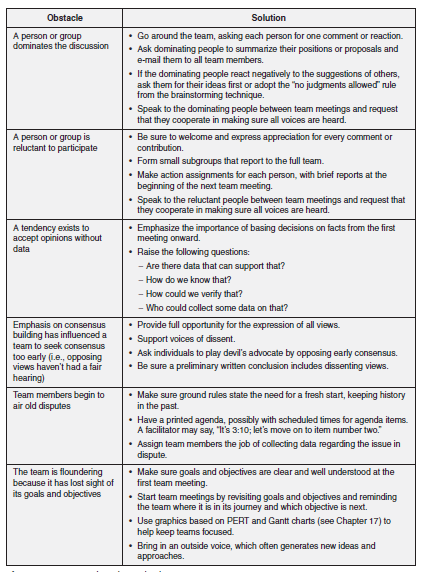
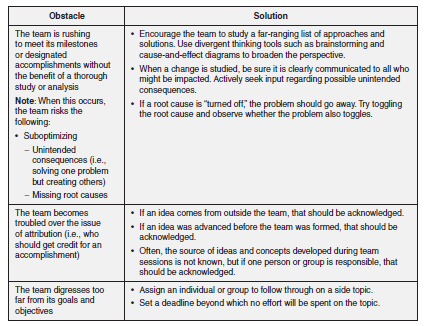
Without good leadership, a team can backslide from norming or
performing into any previous stage. If a team leader or facilitator observes signs that backsliding is occurring, the team leader should remind the group of the goals and agenda and the need to press forward. Team members who are accustomed to working with each other on similar projects may be able to skip the storming stage and possibly the norming stage. There have also been examples of teams that perpetually cycle through the forming, storming, and norming stages, never to reach the performing stage. Such teams tend to suffer a slow death and may never be officially adjourned.
Team Communication:Lack of adequate communication is one of the most frequently noted causes of team failure. Serious effort toward communication improvement should be made at each stage of team development. In some situations, such as large projects or those
with wide geographical barriers, the development of a formal communications plan is necessary. This is particularly true in the case of virtual teams.
Team Dynamics:
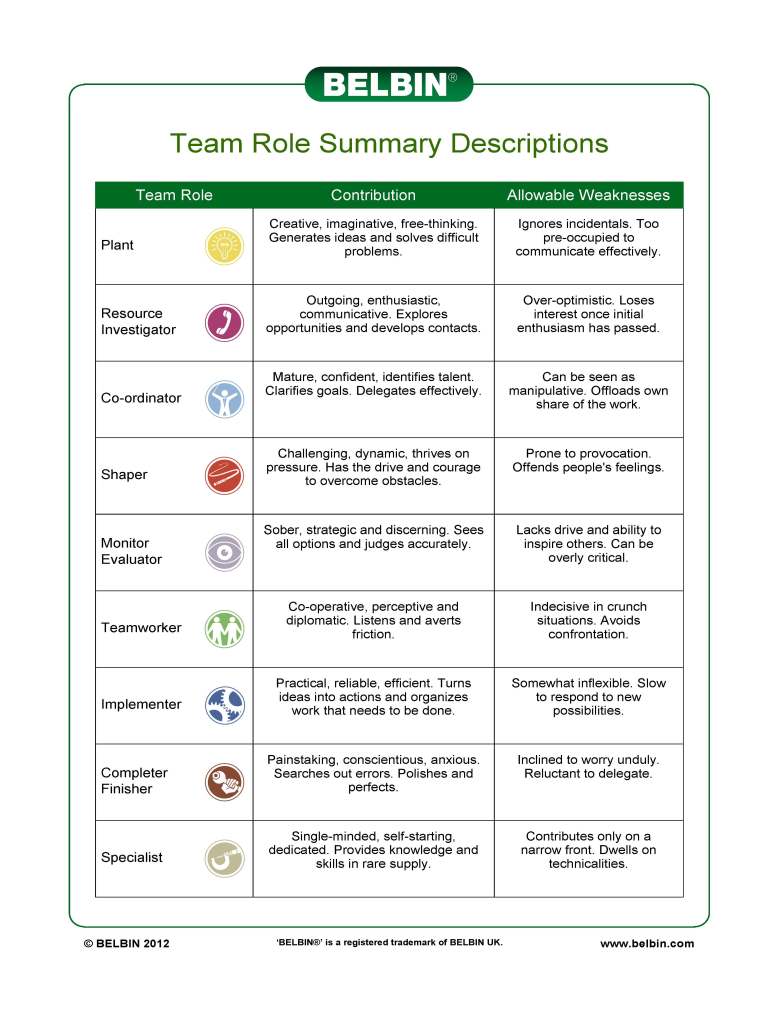
Once teams have been formed, they must be built, because a true team is more than a collection of individuals. A team begins to take on a life of its own that is greater than the sum of its parts. The building of a team begins with well- trained members who understand roles and responsibilities of team members and how they may differ from roles outside the team.
The best model for team leadership is the coach who strives to motivate all
members to contribute their best. Productive teams occur when team coaches facilitate progress while recognizing and dealing with obstacles. The coaching function may be performed by team leaders or team facilitators or both.
Time Management: Time is perhaps the most critical resource for any team. Team meeting time must be treated as the rare and valuable commodity that it is. It is up to the team leader and the facilitator to make every minute count, although every team member has this responsibility as well. Some practices that have proved useful follow:
• Form an agenda committee that will generate the meeting agenda well
in advance of the scheduled meeting. This group can be responsible
for getting the resources called for by each agenda item. For smaller
teams, the team leader often prepares the agenda.
• Use a Gantt chart timeline displaying milestones and dates, updating
as needed.
Publish meeting agendas with time limits on each item. Assign a
timekeeper and stick to the schedule as closely as possible. Leave five
to ten minutes as a buffer at the end of the session.
• Publish reminders of members’ action assignments. In some cases,
the team leader will want to review progress on these assignments
between meetings. Effective time and meeting management is something that requires training and practice to master. The team coach might want to consider having the whole team trained in these topics as part of an intervention.
Team Decision Making Tools:
Nominal group technique (NGT) is used to prioritize a list of items. Each team
member writes on a slip of paper the letters designating a list of items. For example,if there are four items, each team member writes the letters A, B, C, and D and then ranks each of the items, using a higher number for a higher ranking. The highest- ranking item would be marked “4,” the next highest would be marked “3,” and so on. The totals are compiled for each item and represent the team’s consensus. Items with the highest totals are the priority items to be worked on by the team.
In force field analysis, a goal or objective is first listed as the future or desired state. The lists in the two columns are produced from brainstorming or a similar technique. The first column, “Driving force,” lists the things that help make the future state occur, and the items in the second column,
“Restraining force,” are those that prevent the future state from occurring. The team then ranks the two lists, using NGT or a similar tool. The team consensus provides guidance on how to proceed. Depending on the organizational environment in which this technique is used, it may be more effective to focus on reducing or eliminating the restraining forces than to focus on sustaining or increasing the driving forces.
Multivoting is a variation of NGT in which each team member has 100 points to allocate to the items on the list as he or she feels appropriate, assigning the largest number of points to the highest- ranking item. Points assigned to each item are totaled and ranked accordingly. Items with the most points are worked on first.
Conversion/diversion refers to the two types of thinking that go into each of
the team tools. Diversion refers to those team activities that produce a broad or diverse set of options. When a team needs a number of fresh ideas, diversion techniques are used. A brainstorming session or a session listing possibilities on a cause- and-effect diagram are examples of diversion. Once many options have been listed, conversion activities are used to narrow the list and prioritize items for action. Examples of conversion activities are NGT and multivoting.
Team Performance Evaluation:
At specified points in the life of a team, its progress should be evaluated. The measurement system and criteria should be agreed on in advance. The criteria against which the team is evaluated must relate to progress toward goals and objectives. It is common practice to compare team progress against the timeline set forth in the project schedule. Typical objective-oriented criteria include measurement against:
• Goals and objectives
• Schedule
• Budget
In addition to the above, it may be possible for the team coach to evaluate the team on other criteria, some of which are less objective:
• Attitudes
• Teamwork
• Attendance
• Following team norms
• Length in team stages
The coach will want to attend team meetings from time to time to make evaluations and observations. Above all, the coach will want to determine whether the team is making progress or is heading for a state of imminent failure. If failure is close or imminent, the coach should take immediate action to prevent it.
Team leaders can recognize the team’s efforts as the team reaches various milestones. More formal reward ceremonies at the conclusion of a team’s
project might involve a higher level of management. Here are just a few of the possibilities:
• Evaluations that show personal strength and growth as a team member
• Tokens such as pins, small gifts, apparel, or meals
• Recognition through professional organizations
• Support for publication of results in professional journals
• Recognition in company newsletters
• Financial rewards based on cost savings resulting from the project
 All about Pharmaceuticals & Medical Devices